About cities and inequalities, new study by Sony CSL - Rome featured in Nature Cities
“A universal framework for inclusive 15-minute cities”, the recent publication by the Sustainable Cities Research Line at the Sony Computer Science Laboratories - Rome ends up in the monthly online journal by Nature.
“A universal framework for inclusive 15-minute cities”, the study by Matteo Bruno, Hygor Piaget Monteiro Melo, Bruno Campanelli led by Vittorio Loreto from the Sustainable Cities Research Line at Sony Computer Science Laboratories - Rome (Sony CSL - Rome) has been featured in Nature Cities and the content has been deemed to be of high interest to the scientific community. (Available here: https://www.nature.com/articles/s44284-024-00119-4).
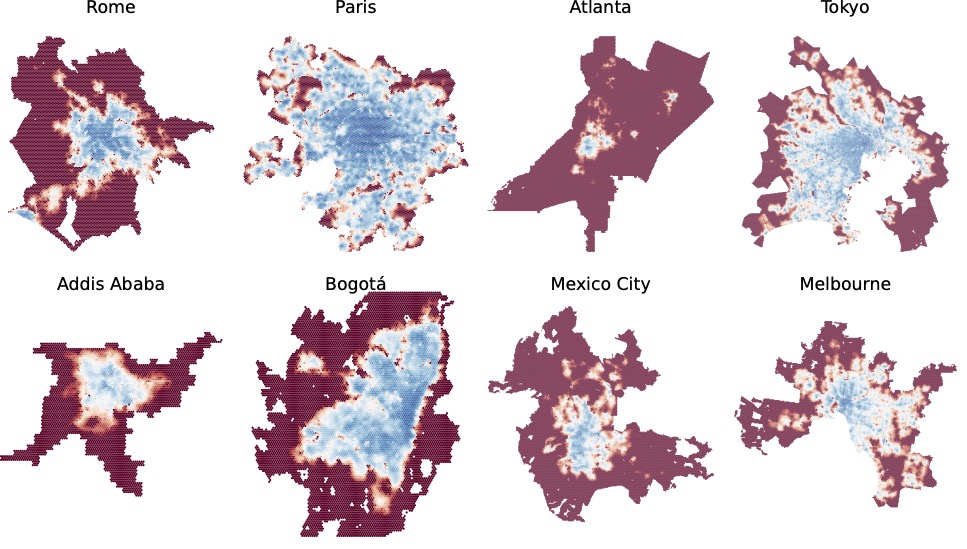
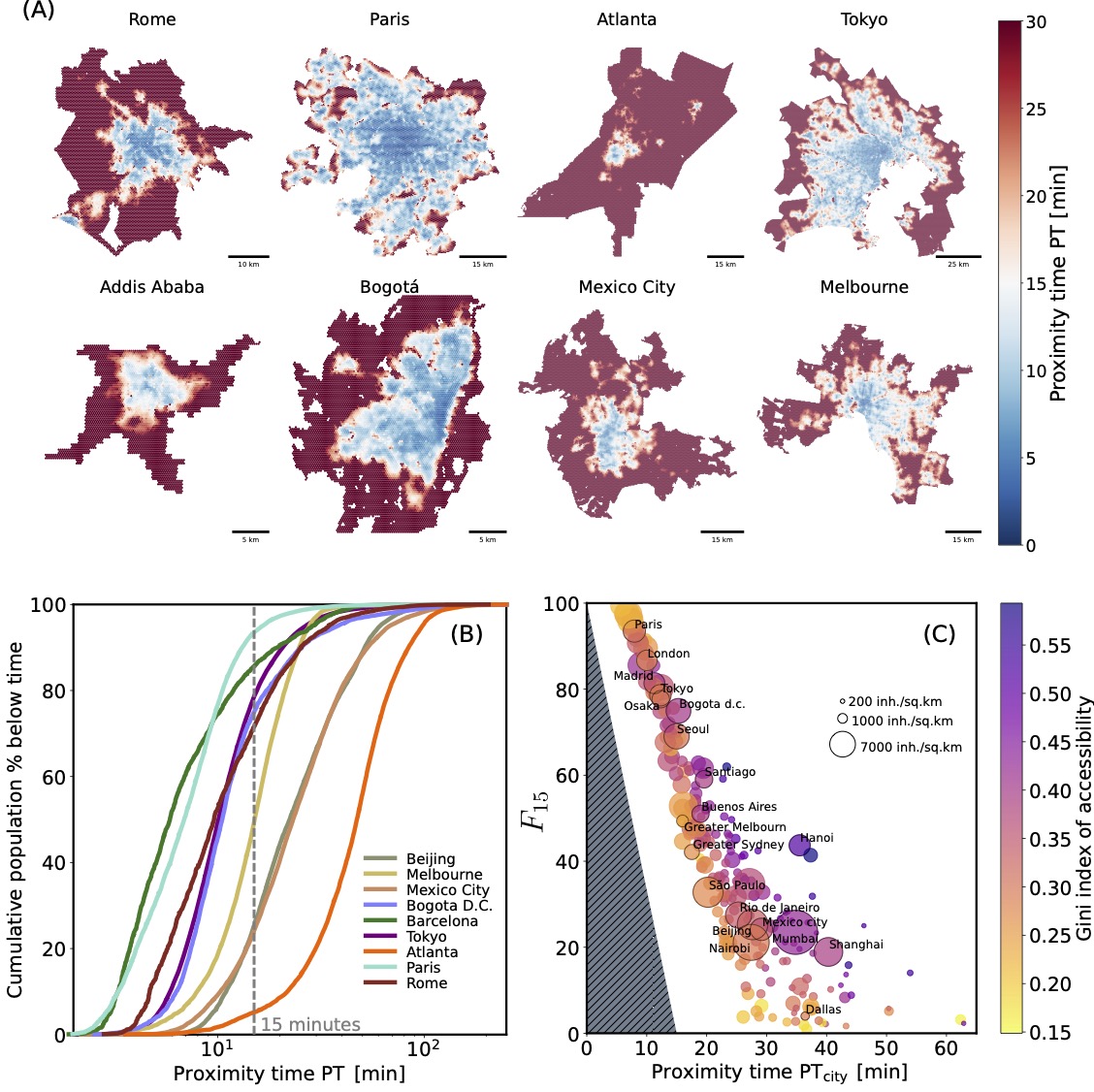
The paper “A universal framework for inclusive 15-minute cities” starts from the concept of the 15-minute city, which proposes that urban areas can operate more efficiently, fairly, and sustainably when vital everyday services and essential amenities are accessible within a 15-minute distance of walking or biking. The study analyses a vast number of cities worldwide and finds that, within the framework of the 15-minute city, the accessibility to services by citizens is highly heterogeneous within and across cities, meaning that urban areas present a high level of inequalities given mainly by the poor or difficult accessibility to services by citizens.
At this point, the research group at Sony CSL - Rome went a step further, looking at the idea of proximity from a different point of view: can we improve how services are located on a given territory so that their accessibility also improves? Instead of focusing only on how we can easily reach services, let’s consider the following: Does a neighbourhood need a massive transportation enhancement to reach essential services or a more capillary spreading of essential proximity services?
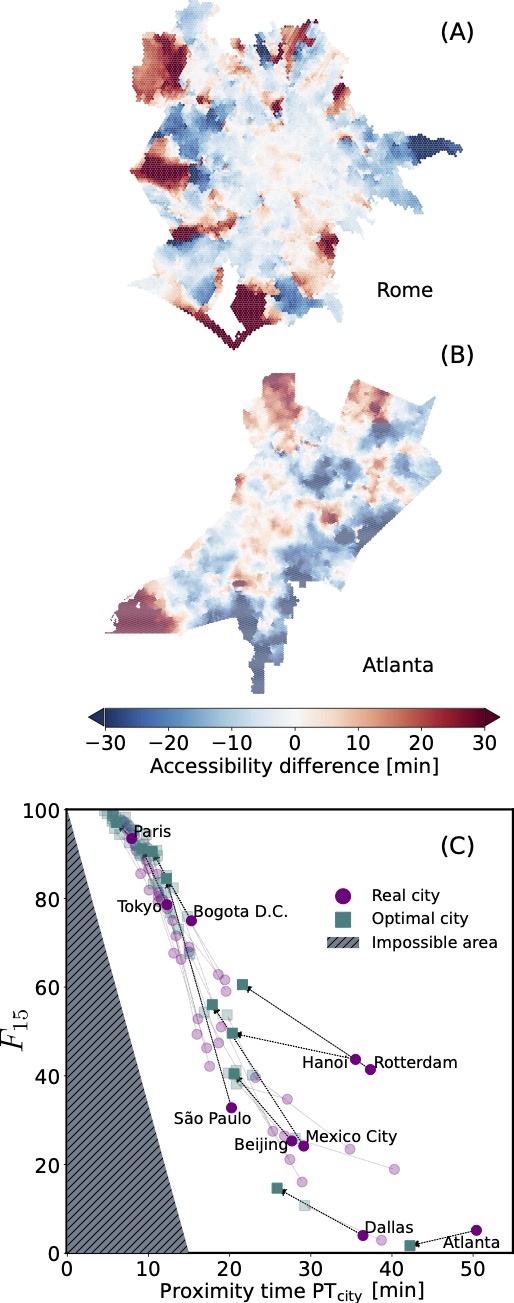
The researchers tried to answer these questions by creating a “relocation algorithm,” which will help understand how to increase the number of citizens who can access services in a given urban area and reduce inequalities. In addition, the “algorithm” is also essential in simulating how a city would respond to an increase in services until it reaches the 15-minute framework and how the number of needed services can vary among different cities.
But why is all this useful? Well, in principle, to have a better comprehension of the cities we live in, of the complex problems citizens face and of the complex possible solutions, but also to understand that cities are different to each other, and they need tailored solutions to their complexities and the 15-minute framework is just one of the possible scenarios. Managing such a tool, urbanists, engineers, and policy-makers could concentrate on non-standardised solutions for their cities; on the contrary, they could work on the most suitable ones in a way that cities are more accessible to a more significant number of people.
The benefits of more equitable cities are infinitely varied: having better access to healthcare, education, culture, amenities, and all the range of opportunities cities can offer as centres of human creativity makes us better citizens of the entire world.
Nature Cities is the monthly online journal that publishes insightful research and opinions about cities and urban issues broadly, aiming to deepen and integrate basic and applied understanding of the nature of cities, including their roles, impacts, influences, past, present, and future. At this scope, the journal features cutting-edge research, synthetic reviews and timely news and opinions. By bringing together diverse content and voices, it aims to transcend divides among disciplines, regions, researchers, practitioners, policymakers, and the public. (ref: https://www.nature.com/natcities/journal-information)
Sony CSL - Rome, was founded in 2021 to lay the foundations for a new research entity that brings together, in a single conceptual space, the sciences, the arts, and public engagement to drive innovation towards the Sustainable Development Goals (SDGs). The lab is led by Prof. Vittorio Loreto.For us at Sony CSL - Rome, creativity is an indispensable tool. We promote an original approach in which humans and machines collaborate to seek sustainable solutions to the current challenges facing society and the planet.
The term “Augmented Creativity,” which describes one of our foundational research lines, precisely encapsulates a renewed synergy between natural and artificial intelligence. This is the main idea behind the foundation of Sony CSL - Rome, in its ambition to combine sciences, arts, and public engagement in a unique ecosystem to promote research, stimulate innovation, and act promptly to “repair the present,” making a concrete future possible for all. (ref: https://csl.sony.it/)
Sony Computer Science Laboratories
Sony Computer Science Laboratories (Sony CSL) was founded in 1988 to pave the way for new areas of research and paradigms, as well as new technologies and activities, for the benefit of humanity, society, and our planet. From its early forays into next-generation computer systems, Sony CSL has expanded into various research areas and is currently working to address social issues such as ecosystems, urban planning, and energy, while exploring the potential of human capabilities using both AI and robotics. In the pursuit of further value creation, in 2021 Sony CSL opened a laboratory in Rome, which became the fourth location after Tokyo, Paris, and Kyoto.
For more information, visit: https://csl.sony.it/