Flotopia: 10,000 Lumens for an extraordinary Home Cinema in the Alps
In the Austrian province of Vorarlberg, surrounded by majestic alpine peaks, a Sony VPL-GTZ380 4K laser projector displays images onto a 4.18-metre-wide cinemascope screen – in a room that was actually too low-ceilinged for a project of this scale.
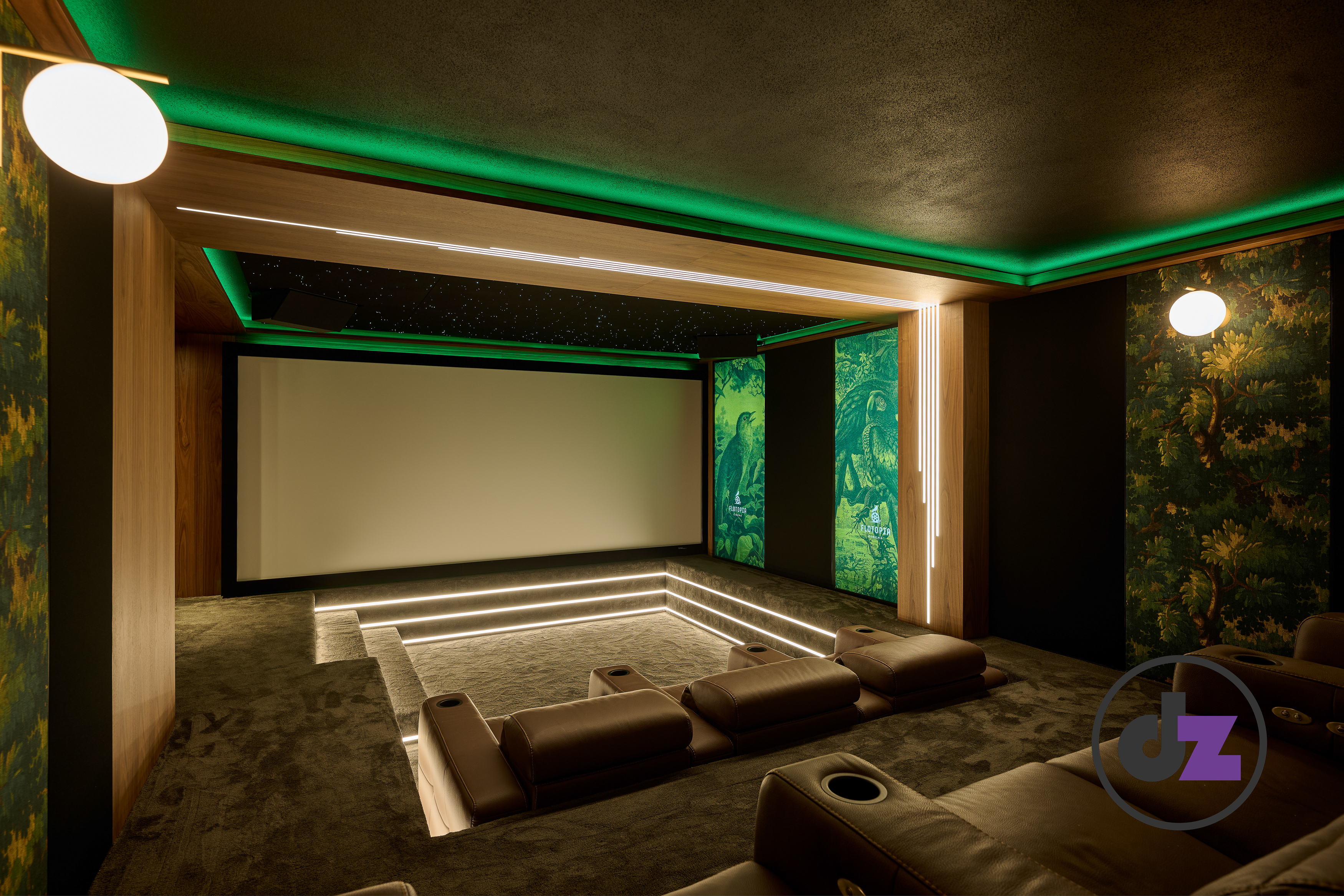
A passionate film fan, an ageing home cinema room with a CRT projector, an impending complete renovation of the house – and a cellar that was actually too small, too low and, to top it all, asymmetrical in its layout. What emerged from this is now known as ‘Flotopia’ and ranks among the most remarkable private cinema rooms in Europe. The jury of the CEDIA Smart Home Awards 2025 honoured the project in the “Best Home Cinema Level III” category. It demonstrates what can be achieved when passion, precision and high-end technology work together in perfect harmony.
Die Zwei – Heimkino GmbH, a partnership between two specialists in audiovisual technology and systems integration, was responsible for the planning and implementation. At the heart of the visual concept is Sony’s VPL-GTZ380 4K laser projector. The VPL-GTZ380 displays images true to the original in native 4K resolution (4096 x 2160) – without resorting to upscaling or pixel shifting, techniques often used in smaller projectors. Even the finest details are breathtakingly sharp and clear, even when the audience is sitting closer to the screen.
Our contribution
The challenge
- Very low ceiling height and an asymmetrical floor plan in a small room
- Desire for the largest possible screen and uncompromising HDR brightness
- No technical equipment in the cinema room – no operating noise, no visible devices
- A cosy, inviting room rather than a ‘black box’
The solution
- Sony VPL-GTZ380 SXRD 4K laser projector with 10,000 lumens
- Installed in the rear adjoining room, projecting through an RGB-laser-compatible projection window
- Bespoke, acoustically transparent Cinemascope screen, 418 cm image width in 2.40:1 aspect ratio
- Air-conditioned and sensor-monitored projector housing, fully fibre-optic signal routing
The result
- Breathtaking images in a challenging environment
- 56° horizontal viewing angle and 9° head tilt at the reference seat – Level 4 of the RP23 industry recommendation
- A cinema room that is also used for purposes other than film screenings
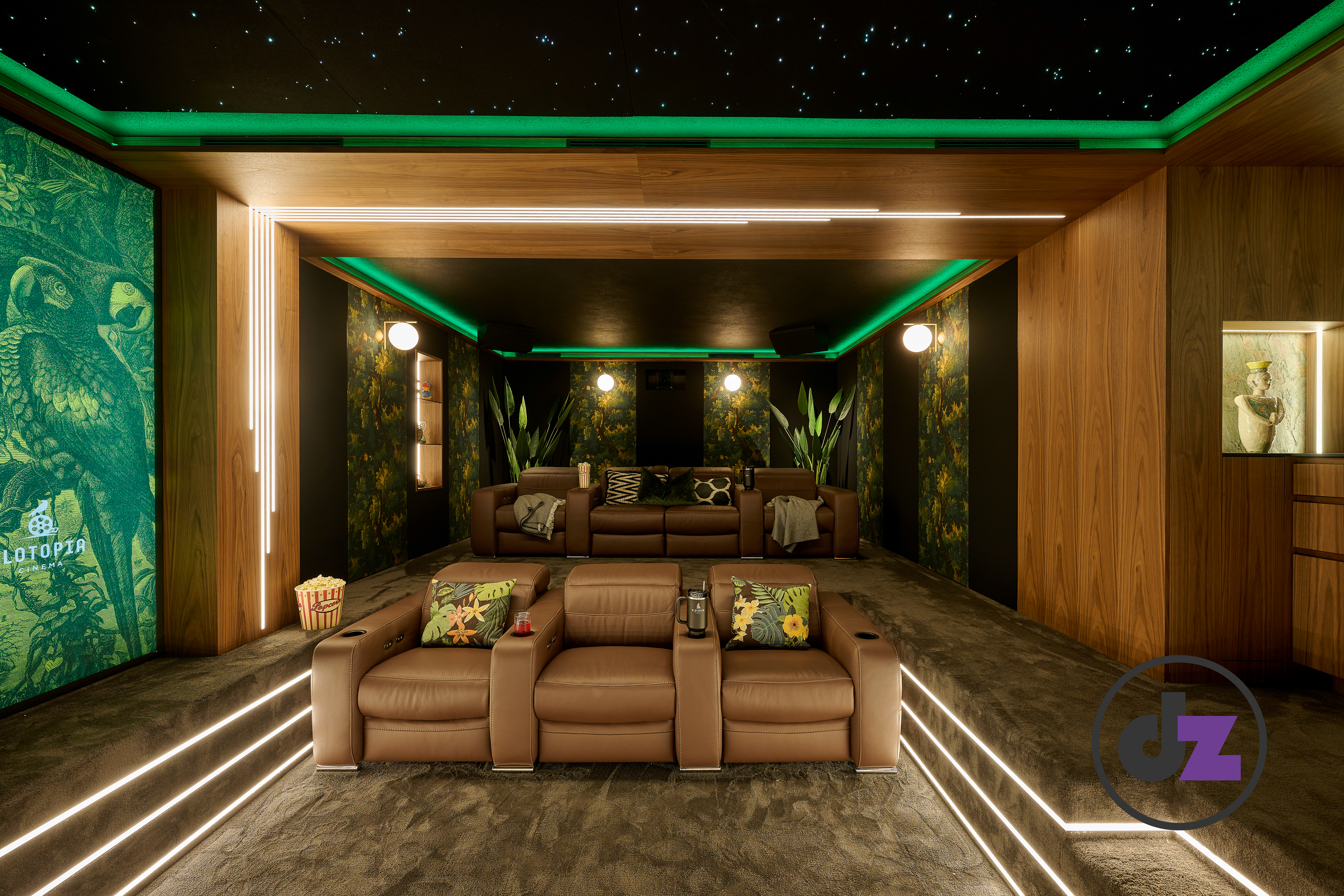
A cinema in the Alps
The client had set up his first cinema room himself: a simple sound system, a valve projector, and plenty of enthusiasm. When the time came to renovate the entire house, it quickly became clear that this room deserved a complete redesign.
The challenges became apparent right at the start of the project: the room was small and the ceiling was low. A rarely used adjoining room was therefore incorporated into the design and the partition wall between them removed. Whilst the structural work was underway, the client also decided on a step that was initially intended only as a technical stopgap: the floor in the front section of the room was lowered. This makeshift solution became a defining design feature. The resulting ‘pit’ accommodates the front row of seats, provides the necessary headroom for sightlines and ceiling speakers – and, accentuated by a ring of light strips, became the visual centrepiece of the room.
As big as possible – yet still safe
The client’s key requirement for the screen was: as large as possible. Given the ceiling height, the decision was therefore made to opt for a Scope format. A screen width of 418 cm with an aspect ratio of 2.40:1 is exactly the maximum that could be fitted into the front section.
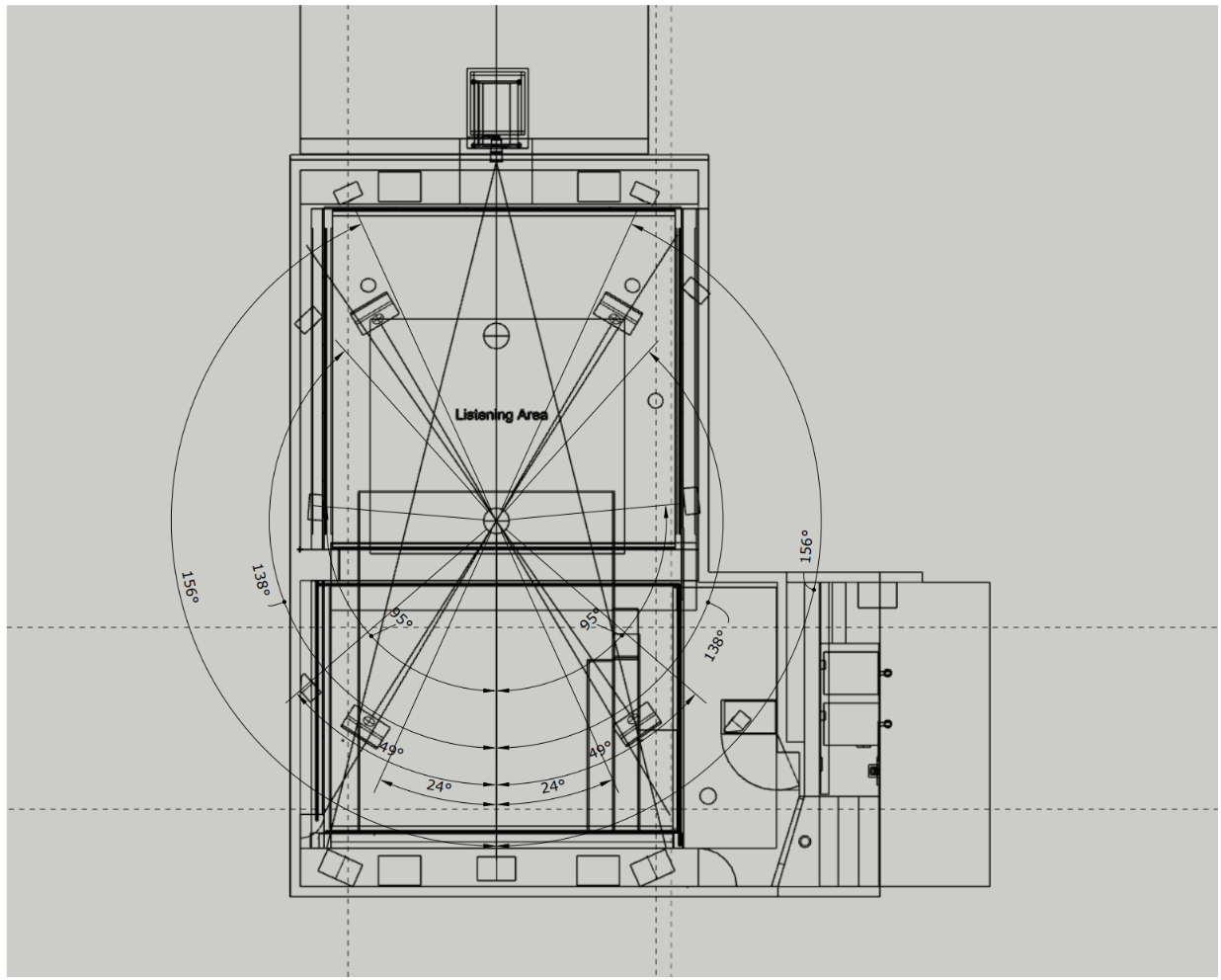
From the reference seat, this results in a horizontal viewing angle of 56° with a head tilt of 9° – both within the seating geometry requirements of the International Association of Home Cinema and Smart Home Specialists (CEDIA) and the US Consumer Technology Association (CTA). The team had already checked, using a VR simulation during the planning phase, whether there would be an unobstructed view from the outer seats in the second row. This prediction was confirmed exactly once construction was complete. The image must fill the field of view to the same extent as in a cinema auditorium – without the viewer having to tilt their head back. It was precisely this balance between ‘big enough’ and ‘too close’ that the team achieved at Flotopia.
An acoustically transparent screen allows the sound from the three front speakers to pass through unimpeded – but at the expense of light. Combined with the image size and the requirement to reproduce HDR content with true peak brightness, this resulted in lighting requirements in the five-figure lumen range.
Another factor, often underestimated during the planning stage, was the deciding factor in choosing the VPL-GTZ380: the projector is classified as Risk Group 2 according to IEC 62471-5. Unlike with Risk Group 3 devices, this means there is no need to keep a restricted area clear in front of the lens, into which no one is allowed to look. Given the low ceiling height and the limited clearance above the rows of seats, this was precisely the condition that made this room feasible in the first place.
“The room didn’t make things easy for us. Sony’s VPL-GTZ380 has opened a door for us here that would otherwise have remained closed.”
Thorsten Köhler, Die Zwei – Heimkino GmbH
The projector nobody can see
One of the key requirements was: no technical equipment visible in the cinema room. Behind the room was a basement area used for storage and as an exit – ideal for the projection. The VPL-GTZ380 operates there inside a custom-built, ventilated enclosure and projects through a projection window onto the rear wall of the cinema.
The enclosure is deliberately generously sized and protects the unit from dust. Temperature and humidity sensors monitor the interior, and the ventilation adjusts automatically. If defined thresholds are exceeded, the system shuts down in a controlled manner and reports the status to the integrator’s support team. The projection window is already designed to accommodate RGB laser sources – an investment in the room’s future-proofing.
The signal is routed to the projector via two HDMI 2.1 cables, each approximately 15 metres long and made entirely of fibre optic cable. Using pure fibre-optic cables instead of hybrid cables means there is no electrical connection between the rooms, thus eliminating hum and the risk of surge damage via copper wires. Both HDMI inputs on the projector are in use, allowing future sources to be connected without the need for modification. The racks, projector and network are earthed via a shared equipotential bonding system.
Calibration as a workflow
Three separate 3D-LUTs were created for image calibration: one for SDR content with a target white point according to Rec. 709 and 100 nits; one for 4K HDR material according to DCI-P3 with a peak brightness of over 200 nits; and a separate set of data for 3D. The reason for this division lies in the laser operation itself: different output powers result in slightly differing white points, which can only be accurately compensated for using separate profiles.
This has been thought through consistently in terms of operation. The owner can adjust the projector’s laser output via the remote control – for example, when showing very dark content or films with a raised black level. Each of these settings is linked to the appropriate tone-mapping profile in the upstream video processing system. This ensures that the two systems remain perfectly synchronised at all times, rather than working at cross-purposes.
When it came to the projector’s image optimisations, the team adopted a deliberately minimalist approach: these remain largely deactivated. The native reproduction of the SXRD panel and the calibrated colour tuning carry the image – without any downstream interventions that might compromise highlights or detail. Instead, the projector’s built-in interframe calculation is utilised, which further enhances the panel’s motion sharpness.
“Thanks to its laser light source, which contains a red laser diode alongside the two blue laser diodes with different wavelengths, the VPL-GTZ380 achieves the full DCI-P3 colour space – which is 1.35 times wider than the sRGB of other projectors – without any loss of brightness.”
Adrian Bond, Product Marketing Manager, Sony Europe
One system, one remote control
As complex and comprehensive as the technology is, operation remains simple. A central control system brings together picture, sound, lighting, screen masking and room ventilation.
The homeowner begins the evening at a 17-inch touch panel next to the entrance – which even displays a live preview of the projected image – then picks up the handheld remote control and enters the already illuminated room.
On the audio side, a 24-channel audio processor works with an 11.1(8).4 layout comprising fully active loudspeakers developed in-house by the integrator. Eight 18-inch subwoofers – four at the front and four at the rear – use wavefield-based bass control to produce an exceptionally even distribution of low frequencies across both rows of seats – no mean feat in an asymmetrical room.
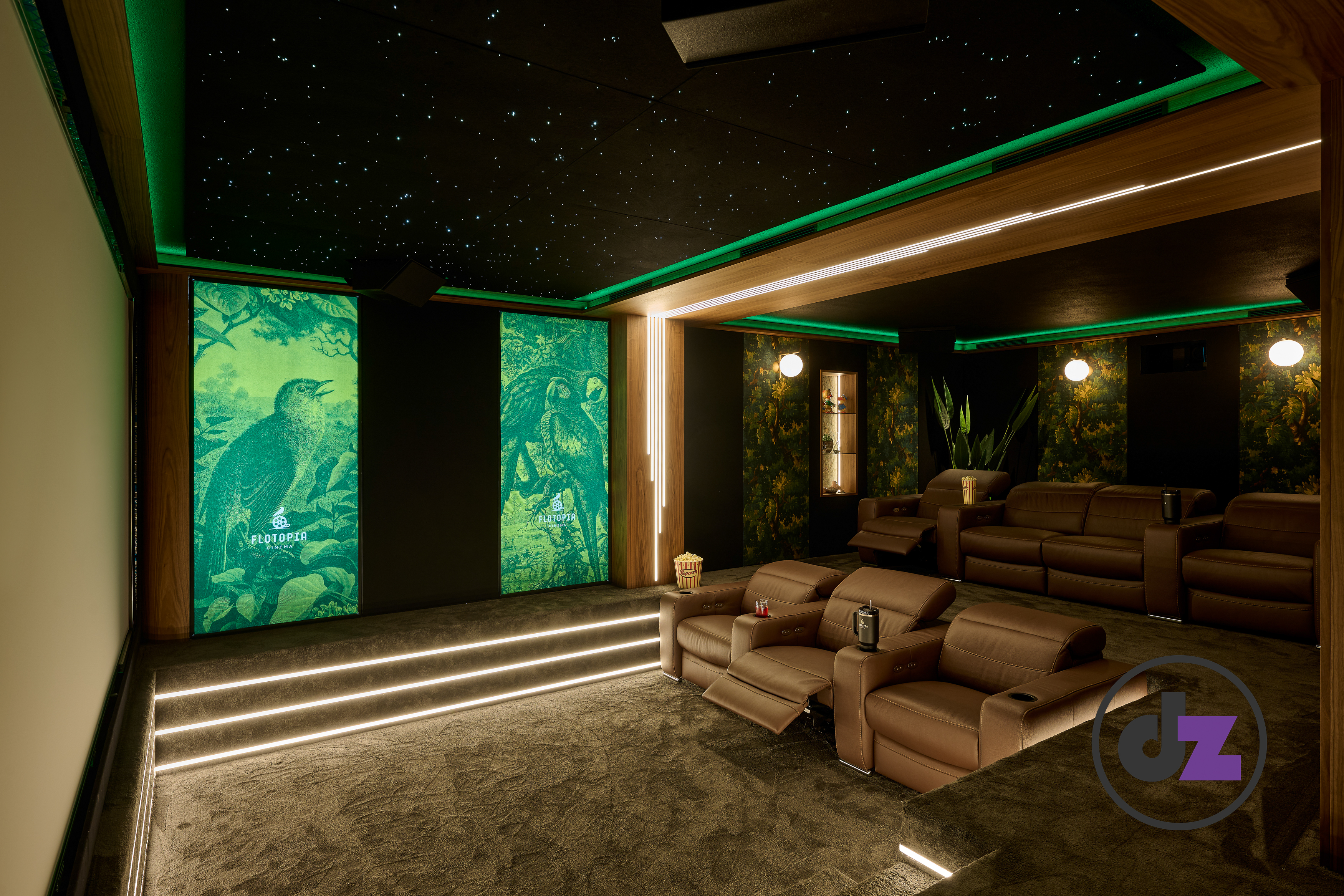
The lighting design comprises around 20 separately controllable zones, ranging from the light strip running along the pit to backlit fabric frames and a starry sky featuring randomly triggered shooting stars. The aspect ratio detection operates deliberately in a semi-automatic manner: The system detects the aspect ratio and displays it on the remote control, but the masking only activates when triggered by the user – this ensures the room remains undisturbed during rapid format changes.
The result
Flotopia went live in May 2025. A total of three on-site visits by the integrator Die Zwei – Heimkino GmbH were required. Most of the programming and configuration had been prepared beforehand in the company’s own workshop.
“For us, a true home cinema is more than just state-of-the-art technology. It is the perfect interplay of design, architecture and atmosphere, created for moments that linger in the memory. And that is exactly what we’ve achieved”
Florian G., Vorarlberg, Austria, Flotopia
The room is by no means used solely for watching films. The bar in the entrance area, the cosy atmosphere, the steps leading down to the pit and a games console concealed behind a door have turned the cinema room into a place where the family gathers not just to watch films – exactly as the client family had envisaged.
Related products
https://pro.sony/de_DE/products/4k-home-cinema-projectors/vpl-gtz380-home
Further Links
https://pro.sony/de_DE/products/home-cinema-projectors