Sony introduces OCELLUS, its new Camera Tracking System for the creation of Spatial Content in Augmented Reality or Virtual Production
OCELLUS enables stable marker-free tracking with multiple sensors and seamless camera integration for cinematic and broadcast applications, including sports, news, and weather news
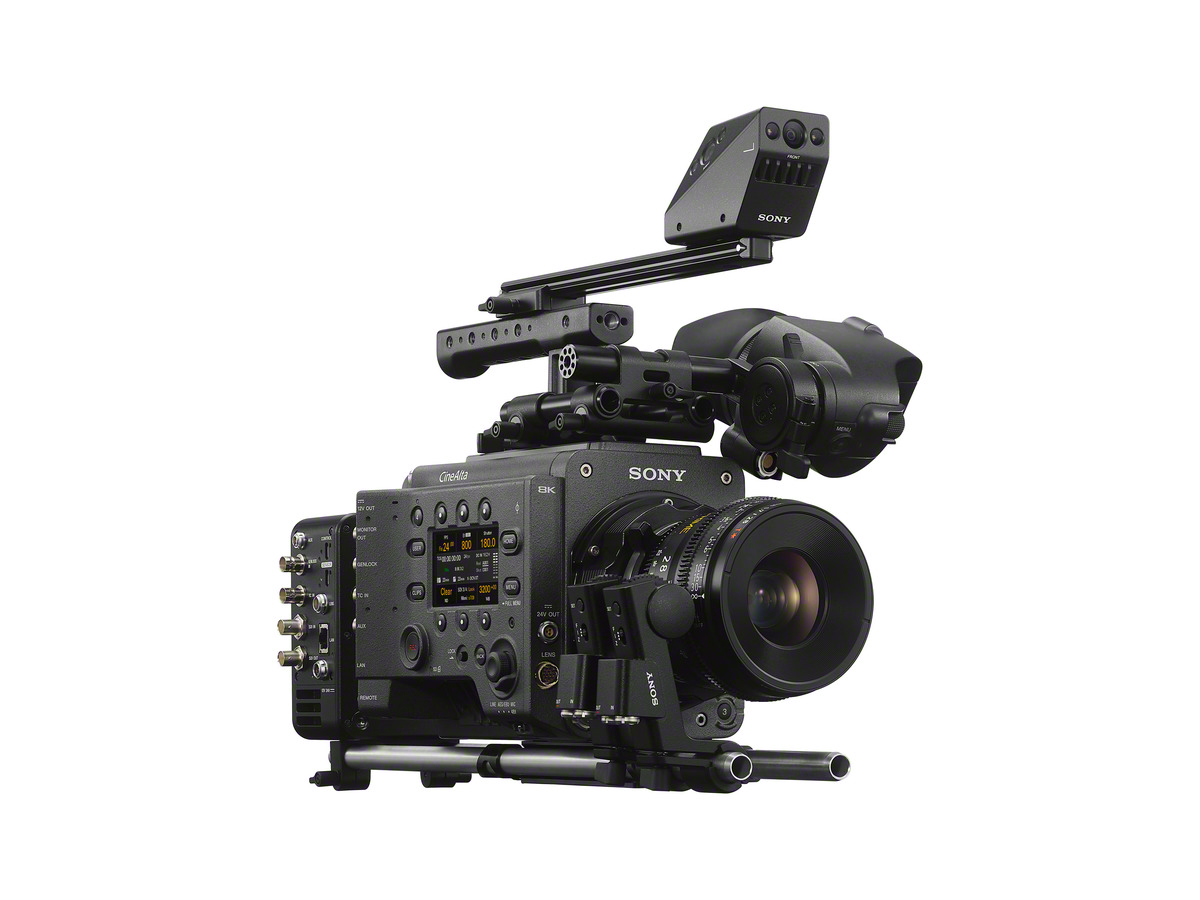
Weybridge, March 18th, 2025 – Sony is launching its first camera tracking system, OCELLUS (ASR-CT1), specifically designed to simplify and facilitate augmented reality and virtual production applications in broadcast and cinema by providing marker-free camera tracking through multiple sensors. OCELLUS is camera agnostic and can be used with both cinema and broadcast cameras.
“The growing market for virtual production and AR demands simpler, more efficient workflows. Metadata like camera position and lens values are crucial for pre- and post-production,” said Sebastian Leske, Head of Business Development, Cinema Line. “Our new camera tracking system delivers valuable, real-time data, enhancing efficiency based on insights from content creators worldwide.”
OCELLUS, perfectly suited for virtual production such as In-Camera VFX and AR, sends the camera position and orientation data while the camera is shooting. The system comprises a sensor unit, a processing box, and three lens encoders, and can be used with Sony Cinema Line cameras, system cameras, and non-Sony cameras.
With the five image sensors and Sony's Visual SLAM (Simultaneous Localization and Mapping) technology, the system creates a reference map[1], enabling stable marker-free tracking both indoors and outdoors.
When using Sony cameras, metadata regarding about focus, iris and zoom values from the camera and lens[2] can be obtained via the camera's SDI[3] output and transmitted in real-time to external devices via Ethernet cable[4]. If the lens does not support metadata acquisition through the camera, lens encoders can be affixed to the camera to obtain this metadata. The acquired metadata can then be used for virtual production and AR. The system also supports recording tracking data, camera/lens metadata, timecode and file name, which can be used for the post-production workflow.
Sony continues its unwavering support to creators in the Virtual Production and AR space, with tools ranging from acquisition to display screens such as the Crystal LED VERONA and software-based solutions such as the Virtual Production Toolset.
Key Features
Compact and lightweight sensor unit with five image sensors:
- Four image sensors out of five on the sensor unit are selected to use, providing stable marker-free tracking and high occlusion resistance, critical for operations
- If at least one image sensor in use captures valid feature points, tracking data can be extracted
- IR LEDs on both sides of each image sensor help tracking in low-light environments
- Visible Light Cut Unit included for stable tracking in environments with frequent lighting changes
- Sensor unit dimensions: approx. 86 mm × 60 mm × 43 mm (W × H × D) (3.39" × 2.36" × 1.69"), weight: approx. 250 g[5]
- Easy installation and position adjustment using the NATO rail mounting parts (included)
- Connection to the processing box via a single USB Type-C® cable with a lock mechanism, powered by the processing box via same USB Type-C® cable
Processing Box:
- Real-time transmission of tracking data and camera2/lens3 metadata to CG rendering software like Unreal Engine via Ethernet cable[6] in free-d format
- Equipped with Genlock input, Timecode input, SDI input/output terminals, and lens encoder connection terminals
- Supports recording tracking data and camera/lens metadata as FBX files on SDXC memory cards (UHS-II/UHS-I) synchronized with video files of main camera
- OLED display for checking IP address, tracking information, lens data, and more
Lens Encoder:
- Detects precise rotation angles and positions of lens focus, zoom, and iris values
- Transmits detected data to the processing box via LEMO 7-pin cable
- Enables metadata acquisition for lenses and cameras not supporting lens data embedding on SDI output
- Includes five different types of gears for various lenses
The camera tracking system OCELLUS 'ASR-CT1' will be exhibited at the NAB (National Associations of Broadcasters) Show 2025 in Las Vegas, USA, starting April 6, 2025 on the Sony booth.
Further information available at:https://pro.sony/products/camera-adaptors/ocellus
**Model Name:** Camera Tracking System OCELLUS (ASR-CT1)
**Release Date:** Fall 2025 (October 2025 or later)
About Cinema Line
Cinema Line is a series of cameras that have a cinematic look – cultivated from Sony’s long experience in digital cinema production – plus enhanced operability and reliability that respond to the wide variety of creators’ high demands.
Cinema Line includes the high end CineAlta cameras VENICE, VENICE 2 and BURANO, as well as the various FX models and the unique FR7 PTZ camera. Sony’s flagship digital cinema camera VENICE has been used on over 500 feature films, television and commercials, including three of the top grossing feature films in the world in 2022. The Cinema Line includes the professional camera FX9, which is popular for documentary and drama production and the FX6, for grab and shoot action and content creation. With the addition of the FX3 and FX30, the most compact cameras in the series, Sony offers a true line up of versatile creative tools for all types of visual storytellers.
About Sony Corporation
Sony Corporation is a wholly owned subsidiary of Sony Group Corporation and is responsible for the Entertainment, Technology & Services (ET&S) business. With the mission to “create the future of entertainment through the power of technology together with creators,” we aim to continue to deliver Kando* to people around the world.
For more information, visit: http://www.sony.net/
*Kando is a Japanese word that roughly translates to the sense of awe and emotion you feel when experiencing something beautiful and amazing for the first time.
[1] There are limitations to the size of the map.
[2] Supports Cooke /i lenses, B4 lenses, and E-mount lenses.
[3] The camera must support metadata embedding on SDI output.
[4] Compatible with 1000BASE-T, 100BASE-TX, 10BASE-T
[5] Please note that the final specifications may differ.
[6] Compatible with 1000BASE-T, 100BASE-TX, 10BASE-T